Cervical Myelopathy in Singapore
Understanding Symptoms, Causes, and When to Seek Specialist Evaluation
Cervical myelopathy is a progressive condition caused by compression of the spinal cord in the neck. It can affect hand coordination, balance, and overall mobility. Early recognition and timely evaluation are important to protect long‑term neurological function. This article provides evidence‑based information to help individuals understand how cervical myelopathy presents and how it is typically assessed in Singapore.

Patient Feature: Warren’s Story
Warren, a 68‑year‑old retiree, began noticing difficulty walking in a straight line and veering sideways without realising it. Simple tasks such as buttoning his shirt or using chopsticks became unexpectedly challenging. Concerned by the rapid changes, his wife brought him to their GP, who recognised the seriousness of his symptoms and referred him to a spine specialist.
After clinical assessment and imaging, Warren was diagnosed with cervical myelopathy. His story highlights the importance of early recognition and timely specialist evaluation, especially when symptoms evolve quickly.
What Are the Symptoms?
- Neck stiffness or tightness
- Hand clumsiness or difficulty with fine motor tasks
- Unsteady gait or balance problems
- Weakness, numbness, or reduced coordination in the arms or hands
- Spasticity or exaggerated reflexes
What Are the Risk Factors?
- Age above 50 (degenerative changes)
- Congenital narrowing of the cervical spinal canal
- Ossification of the posterior longitudinal ligament (OPLL)
- Previous neck trauma or instability
- Asian ethnicity (higher prevalence of OPLL)
- Conditions associated with skeletal dysplasia
What Causes Cervical Myelopathy?
- Degenerative cervical spinal stenosis
- Disc herniation or disc bulging compressing the spinal cord
- Bone spurs (osteophytes) narrowing the spinal canal
- OPLL causing progressive pressure on the spinal cord
- Trauma, instability, or ligamentous thickening
How Is It Diagnosed?
- Neurological examination (e.g., reflexes, gait assessment, Hoffman’s sign)
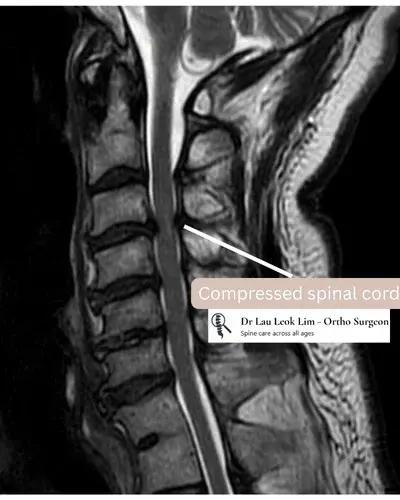
- MRI of the cervical spine to evaluate spinal cord compression
- CT scan to assess bony narrowing or OPLL
- Electrophysiological studies when diagnostic clarification is needed
Coexisting Condition: Cervical Radiculopathy
Some individuals with cervical myelopathy may also experience cervical radiculopathy — a condition where one or more cervical nerve roots become compressed. While myelopathy affects the spinal cord and leads to symptoms such as hand clumsiness, gait imbalance, and coordination difficulties, radiculopathy affects the nerve roots and typically causes radiating arm pain, numbness, or weakness.
When both conditions occur together, patients may notice a combination of symptoms: arm pain or tingling from radiculopathy, alongside balance issues or hand dysfunction from myelopathy. Recognising this overlap is important, as it may influence both diagnostic evaluation and treatment planning.
You may read more about cervical radiculopathy here: Cervical Radiculopathy – Neck & Arm Pain .
What Are the Treatment Options?
Non‑Surgical Management
- Activity modification and fall‑risk reduction
- Physiotherapy focusing on balance and coordination
- Medications for spasticity or inflammation
Surgical Intervention
- Anterior cervical discectomy and fusion (ACDF)
- Posterior cervical decompression and fusion
- Laminoplasty (motion‑preserving decompression)
Conclusion
Cervical myelopathy is a serious condition that can affect mobility, hand function, and overall independence. Early recognition and timely evaluation are important to protect spinal cord function. For individuals seeking more information about spine conditions, you may learn more about the author here: Dr Lau LL – Profile Page.
Frequently Asked Questions (FAQ)
1. Why is surgery needed for cervical myelopathy?
Surgery is recommended when cervical myelopathy reaches a moderate or severe stage. At this point, the spinal cord is sufficiently compressed that there is a risk of sudden worsening. A fall or sudden neck movement may result in significant spinal cord injury, including paralysis. Surgery helps to decompress the spinal cord and reduce the risk of further neurological decline.
2. How much improvement can I expect after surgery?
Most patients experience meaningful improvement in hand coordination, balance, and walking stability. The degree of recovery varies depending on the severity of compression and duration of symptoms. The primary goal of surgery is to prevent further deterioration, and many individuals notice gradual functional gains over several months as the spinal cord recovers.
3. What should I be careful about if I have cervical myelopathy?
Individuals with cervical myelopathy should take precautions to reduce the risk of spinal cord injury:
- Avoid falls — take care on uneven ground, use handrails, avoid slippery surfaces.
- Avoid manipulation of the neck — including forceful massage or chiropractic manipulation.
- Use a walking stick if unsteady — this helps reduce fall risk.
- Avoid high‑risk activities such as contact sports, heavy lifting, or sudden neck movements.