Andrew’s Story — When “Stand Straight” Doesn’t Work
Andrew is a quiet 13‑year‑old boy who prefers screens over sports. His parents often remind him to “stand straight” whenever they notice his upper back rounding forward. At first, they assume it is just posture — the kind that comes from long hours of gaming, studying and scrolling on his tablet.
Over time, something doesn’t feel right. Even when Andrew tries, he cannot fully straighten his back. His shoulders stay rounded, and his upper spine seems fixed in a forward curve. His parents grow concerned and start to wonder if this is more than just slouching.
After a clinical assessment and X‑rays, Andrew is diagnosed with Scheuermann’s kyphosis — a structural condition where the vertebrae grow unevenly and become wedge‑shaped, creating a rigid forward curve in the thoracic spine. His curve is severe enough to require surgery. It is a big decision for the family, but one that ultimately helps Andrew regain balance, confidence and comfort in his daily life.
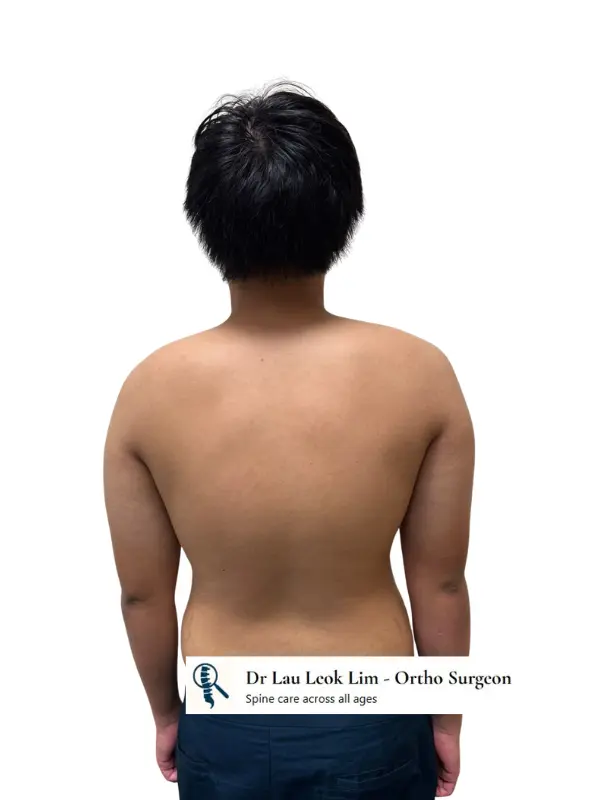
Back appearance of Scheuermann’s kyphosis in an adolescent.
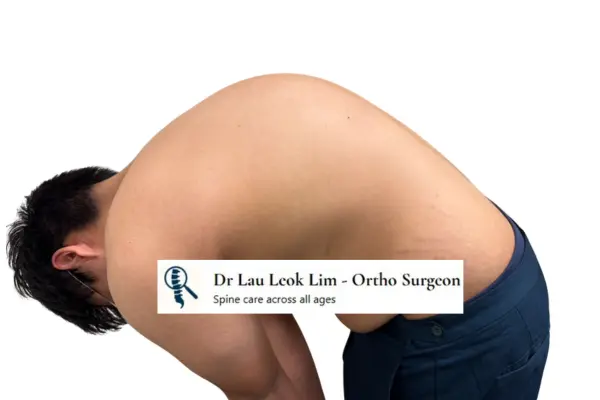
Lateral view showing the rigid forward curvature of the thoracic spine.
What Is Scheuermann’s Kyphosis?
Scheuermann’s kyphosis is a condition where the vertebrae in the thoracic spine grow unevenly. Instead of being rectangular, the affected vertebrae become wedge‑shaped, causing the spine to bend forward more than normal. This is not caused by poor posture. It is a structural deformity, meaning the bones themselves grow in a way that creates the curve.
The condition most commonly appears in adolescents aged 12–16. It is slightly more common in boys and may be noticed more easily in children who are sedentary or spend long hours sitting, although it can also occur in active children.
Common Symptoms
- A noticeable forward curve or “hunch” in the upper back
- Inability to stand fully upright despite trying
- Back fatigue after sitting or standing
- Tight hamstrings or lower back
- Occasional back pain during growth spurts
- Reduced flexibility in the spine
Clinical Signs
- Rigid kyphotic curve that does not correct when standing straight
- Prominent rounding of the upper back
- Tight hamstrings
- Tenderness along the thoracic spine
- Reduced backward bending of the spine
- Wedge‑shaped vertebrae on X‑ray
Postural Kyphosis vs Scheuermann’s Kyphosis
Postural Kyphosis
Postural kyphosis is the most common cause of a rounded back in teenagers. The curve is flexible and usually improves when the adolescent is reminded to sit or stand upright. X‑rays are normal, and there is no vertebral wedging.
For a detailed explanation of postural kyphosis written by Dr LAU Leok Lim, see Sit Up Straight, Darling – HealthHub Singapore .
Scheuermann’s Kyphosis
In Scheuermann’s kyphosis, the curve is rigid. Even with effort, the adolescent cannot fully straighten up. X‑rays show wedge‑shaped vertebrae, irregular endplates and sometimes Schmorl’s nodes. This structural deformity explains why reminders to “stand straight” do not correct the curve.
Treatment Options
Non‑Surgical Options
- Physiotherapy and posture training
- Core strengthening and back muscle conditioning
- Hamstring and lower back stretching
- Activity modification
- Bracing in selected growing adolescents
Suggested exercises to improve posture and spinal mobility.
Surgical Options
Surgery is considered when the curve is severe (often >70–75 degrees), rigid, painful, or significantly affects confidence and daily life. In Andrew’s case, surgery helped him regain a more balanced posture and improved comfort.
For more information on adolescent spine conditions, visit the Adolescent Spine section.
Frequently Asked Questions (FAQ)
1. Is a hunched back always serious?
Not always. Many teenagers have postural kyphosis, which is flexible and correctable. A rigid curve that does not straighten needs medical assessment.
2. How do I know if my child has Scheuermann’s kyphosis?
If your child cannot straighten their back even when trying, or if the curve looks fixed, an evaluation and X‑ray can help distinguish between postural and structural kyphosis.
3. Does chiropractic manipulation help?
Chiropractic or physical manipulation may temporarily ease muscle tightness or knots around the spine. However, it does not change the structural deformity in Scheuermann’s kyphosis, because the underlying issue is the abnormal wedge‑shaped vertebrae, not the muscles.
4. Do elastic posture bands help?
Elastic posture bands are generally not helpful for Scheuermann’s kyphosis. Posture is under voluntary control, and artificially pulling the shoulders back does not correct a structural spinal deformity. It may improve appearance temporarily, but it does not change the curve.