Scoliosis in Adolescents (Adolescent Idiopathic Scoliosis)
If your teenager has been told they have a curved spine, or you have noticed one shoulder or hip sitting higher than the other, this guide explains what happens next.
Adolescent idiopathic scoliosis (AIS) is the most common spinal deformity affecting children aged 10–18. It often progresses silently during growth spurts, which is why timely detection and specialist evaluation matter. This guide explains how it is identified, monitored, and treated in Singapore.
By
Dr LAU Leok Lim
|
lllau@orthohandpartners.com
|
Singapore
Published: 3 September 2025 | Last reviewed: 3 April 2026
What Is Scoliosis in Teenagers?
AIS is one of several types of scoliosis. For an overview of all types across all ages, see our guide to scoliosis treatment in Singapore. If you are new to scoliosis, you may also find our guide on living confidently with scoliosis helpful. For emotional support and patient perspectives, explore Embrace, a self-help book written by a former patient. To see how adolescents return to high-level sport after treatment, visit our featured patient story.
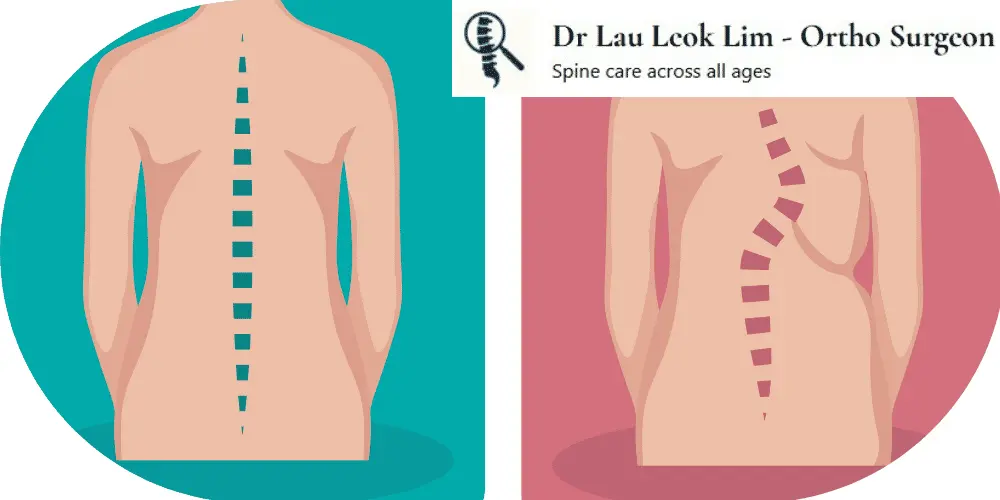
Adolescent Idiopathic Scoliosis (AIS) is a three-dimensional curvature of the spine that develops in otherwise healthy children and teenagers, typically between ages 10 and 18. “Idiopathic” means that the exact cause is unknown, although genetics, growth patterns, and biomechanical factors are believed to contribute.
AIS can progress silently during growth spurts. The example below shows how a young girl’s curve increased from 30° at age 11 to 80° within a few years—a reminder of how quickly scoliosis can worsen without timely monitoring.

Curve progression example: An 11-year-old girl with a 30° curve that progressed to 80° without early intervention.
This highlights the importance of expert follow-up during periods of rapid growth. Early detection allows intervention at a stage when treatment is more effective, less invasive, and more predictable.
To understand how AIS affects daily life, you may also find our guide on living confidently with scoliosis helpful. For an inspiring real-life example of recovery, see how a young athlete returned to competitive sport after surgery in our featured patient story.
See the Curve in Three Dimensions
AIS is a three-dimensional deformity: the spine bends sideways and the vertebrae rotate. Drag the slider to change the Cobb angle, switch on the rib cage, then select the forward-bend view to see why the Adams’ Forward Bend Test reveals a rib prominence.
Loading the interactive spine model…
Thoracic spine · back viewEducational illustration only. It is a generated model, not any patient’s anatomy, and does not replace clinical assessment or an X-ray. Curves are graded here as mild at 10–20°, moderate at 21–44° and severe at 45° and above; management still depends on age, remaining growth and how a curve behaves over time.
How Is Scoliosis Detected in Teenagers?
In Singapore, school screening commonly uses the Adams’ Forward Bend Test to identify early signs of scoliosis. During this test, the examiner looks for asymmetry in the rib cage or lower back. Common indicators include:
- Uneven shoulders or hips
- Rib prominence on one side
- Waistline asymmetry
To see what these signs look like, the visual guide for parents and patients shows each one on a rotating 3D spine and walks through the forward bend test step by step.
If scoliosis is suspected, an X-ray is performed to measure the curve. A Cobb angle above 10° confirms the diagnosis. Additional assessments include skeletal maturity grading (Risser sign), curve pattern evaluation, and growth potential estimation—all of which help determine the risk of progression.
Curve Progression Risk Factors
Not all scoliosis curves behave the same way. Some remain stable, while others progress rapidly. The three strongest predictors of curve progression are:
- Young age at diagnosis — children diagnosed before age 12 have more years of growth ahead.
- Large remaining growth potential — low Risser grade, pre-menarche, or rapid height acceleration.
- Larger initial curve — curves that begin more pronounced are more likely to worsen during growth.
Children with these risk factors require closer follow-up—often every 4–6 months—so that treatment can be initiated at the right time. Early intervention is far more effective than treating a curve that has already reached a severe stage.
For families who want to understand the emotional and psychological aspects of scoliosis, the book Embrace offers practical self-help tools written by a former patient.
Management Strategies
Treatment depends on curve size, growth potential, and the likelihood of progression. Management is personalised and may include observation, bracing, physiotherapy, or surgery.
Observation
For curves 10–20°, regular follow-up is usually sufficient. Most mild curves remain stable, especially once growth slows. Monitoring typically includes periodic X-rays and clinical assessments.
Bracing
For curves 20–40° in growing adolescents, bracing helps prevent progression. Braces are typically worn 16–20 hours daily until growth completion. Bracing is most effective when combined with physiotherapy and good compliance.
Physiotherapy
Methods such as Schroth-based exercises improve posture, core strength, and brace effectiveness. Physiotherapy also helps adolescents maintain confidence and body awareness.
Scoliosis Exercises – Posture and Comfort
Psychosocial Support
Adolescents may face body image concerns or anxiety about their appearance. Support, counselling, and peer communities can help maintain emotional well-being. For practical day-to-day strategies, see our article on living with scoliosis.
When Is Surgery Considered?
Surgery is considered based on the size of the curve and how much growth remains. In a child who is still growing, a curve beyond about 35–40° may be suitable for vertebral body tethering — a growth-modulating procedure that preserves spinal motion. Spinal fusion is generally considered for curves of more than 45°. In selected situations, fusion may also be considered for curves of 40–45°, particularly lumbar curves or where there is significant truncal shift. If you would like to understand why some curves progress quickly, you may revisit our section on curve progression risk factors.
Growth-Preserving Surgery
Vertebral Body Tethering (VBT) is a minimally invasive option for patients with remaining growth. A flexible cord modulates growth to gradually correct the curve while preserving motion.
- Ideal for curves 35–40°+
- Used when bracing fails
- Requires significant growth remaining
Read our full guide to vertebral body tethering in Singapore, which walks through the operation step by step with an interactive 3D model.

Vertebral Body Tethering (VBT) – Growth modulation technique
Vertebral Body Tethering – How Growth Modulation Works
For families exploring motion-preserving options, our featured patient story shows how adolescents return to high-level sports after scoliosis surgery.
Conventional Surgical Methods
For mature patients or severe curves 45–50°+, conventional correction is preferred:
- Posterior Spinal Fusion – realigns and stabilises the spine using rods and screws.
- Keyhole Endoscopic Correction – minimally invasive technique with smaller incisions and faster recovery.

Posterior Spinal Fusion – Stabilization with rods and screws
Posterior Spinal Fusion – Educational Animation

Keyhole Endoscopic Correction – Minimally invasive spinal realignment
To see how adolescents regain confidence and mobility after scoliosis surgery, you may view a Pilates recovery clip on our Instagram: Pilates after scoliosis surgery.
To understand how daily life and confidence evolve after treatment, you may also find our guide on living confidently with scoliosis helpful.
Conclusion
Adolescent idiopathic scoliosis requires timely detection and personalised care. Early evaluation helps ensure that treatment is started at the right stage, whether through observation, bracing, physiotherapy, or surgery.
If you would like to revisit the fundamentals, you may return to our section on what AIS is and how it is detected. For emotional resilience and patient perspectives, the book Embrace offers practical guidance written by a former patient. To explore how adolescents return to sport after treatment, you may also read our featured patient story .
Frequently Asked Questions (FAQ)
1. Who should I see if I suspect my child has scoliosis?
You should consult an orthopaedic surgeon with experience in paediatric and adolescent scoliosis. Early evaluation helps determine whether monitoring, bracing, or treatment is needed.
2. Can scoliosis be treated without surgery?
Yes. Many adolescents with mild to moderate curves benefit from observation, bracing, and physiotherapy. You may revisit our section on management strategies for details.
3. When is surgery recommended?
Surgery depends on the size of the curve and how much growth remains. In a child who is still growing, a curve beyond about 35–40° may be suitable for vertebral body tethering, which preserves spinal motion. Spinal fusion is generally considered for curves of more than 45°, and in selected situations — particularly lumbar curves or where there is significant truncal shift — for curves of 40–45°. You may revisit When Is Surgery Considered? for a full explanation.
4. How much does scoliosis surgery cost in Singapore?
Costs vary depending on curve severity, surgical method, implant type, and insurance coverage. For a detailed breakdown, you may refer to our dedicated guide: Cost of Scoliosis Surgery in Singapore .
5. Can my child return to sports after scoliosis treatment?
Yes. Many adolescents return to competitive sports after recovery. You may explore our featured patient story to see an example of high‑level return to sport.
6. Does scoliosis cause back pain?
Mild scoliosis often does not cause pain, but muscle imbalance or rapid progression may lead to discomfort. Exercises and posture strategies can help — see our guide on living confidently with scoliosis.
7. How often should my child be reviewed?
Children with risk factors for progression typically require follow‑up every 4–6 months. You may revisit curve progression risk factors for more information.
8. Is scoliosis hereditary?
Genetics play a role, but scoliosis does not follow a simple inheritance pattern. Having a family member with scoliosis increases the likelihood but does not guarantee it.
9. Can scoliosis be prevented?
No. Scoliosis is not caused by posture, heavy bags, or sports. However, early detection allows timely intervention and better outcomes.
10. Where can I learn more about coping emotionally with scoliosis?
For emotional resilience and patient perspectives, you may find Embrace helpful — a self‑help book written by a former patient.