
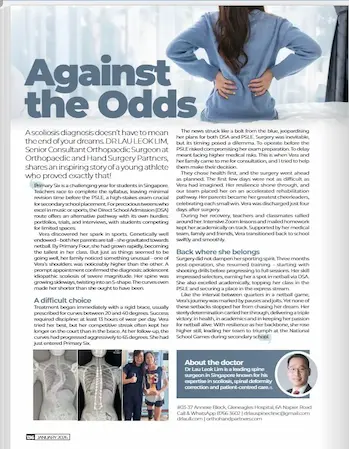
Introduction: When Scoliosis Meets Sporting Ambition
Primary Six is a pivotal year for students in Singapore. Between PSLE preparation and the demanding Direct School Admission (DSA) process, many young athletes face immense pressure. For Vera, a tall and naturally gifted netball player, this year brought an unexpected challenge — a diagnosis of severe adolescent idiopathic scoliosis (AIS).
What followed was a journey marked by resilience, family support, expert care, and an unwavering passion for sport. This is her story.
Understanding Scoliosis in Young Athletes
To learn more about how scoliosis is diagnosed and managed, visit our AIS overview.
- Definition: A sideways spinal curvature measuring ≥10° Cobb angle
- Most common type: Adolescent Idiopathic Scoliosis (AIS)
- Risk factors: Growth spurts, genetics, rapid height changes
- Impact on athletes: Posture imbalance, fatigue, reduced stamina, altered biomechanics
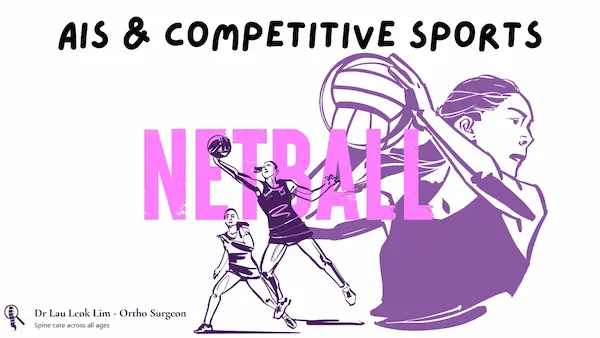
Young athletes with scoliosis often continue to excel with proper guidance and care.
Early Signs: When a Simple Observation Changed Everything
By Primary Four, Vera had grown rapidly and stood head and shoulders above her peers — a natural advantage in netball. But just as everything seemed to be on track, her family noticed something subtle yet concerning: one of her shoulders sat higher than the other.
Treatment began with a rigid brace, typically prescribed for curves between 20° and 40°. For more on bracing, see our section on bracing in AIS.
At her next review, the curve had progressed aggressively to 65°. She had just entered Primary Six.
“The news struck like a bolt from the blue — jeopardizing both her DSA hopes and her PSLE preparation.”
The Surgical Decision: Choosing Health First
Surgery was inevitable — but the timing posed a dilemma. Operating before PSLE risked disrupting her studies and DSA chances. Delaying meant allowing the curve to worsen.
After a detailed consultation, her family made the courageous decision to prioritise health. To understand when surgery is considered, see AIS surgical indications.
At age 12, Vera underwent posterior spinal fusion with segmental instrumentation.
For a clear visual explanation of how posterior spinal fusion is performed, this educational animation may be helpful: posterior instrumentation and fusion explained.
“Surgical correction wasn’t just about alignment — it was about preserving movement, confidence, and competitive edge.”
Recovery: A Team Effort
Vera recovered faster than expected. She required fewer painkillers than most patients and was discharged just four days after surgery.
Supported by her medical team, family, and school, she transitioned back to daily life smoothly.
To see how adolescents regain confidence and mobility after scoliosis surgery, you may view a Pilates recovery clip on our Instagram: Pilates after scoliosis surgery.
Return to Sport: From Shooting Drills to Full Court
Three months after surgery — with medical clearance — Vera resumed training. For more on returning to sports, see our sports recovery feature.
She excelled academically, topping her class in the PSLE and securing a place in the express stream.
“Surgery didn’t end her game — it gave her the strength to play it better.”
Final Outcome: A Triple Victory
- ✔ Full recovery from severe scoliosis
- ✔ Academic excellence in PSLE
- ✔ A leading role in her school’s National School Games triumph
Today, she continues to train confidently with stable spinal alignment and no pain.
Treatment Options for Scoliosis in Athletes
- Conservative: Physiotherapy, bracing, curve monitoring
- Surgical: Posterior spinal fusion, segmental instrumentation, structured return‑to‑sport protocols
Frequently Asked Questions (FAQ)
1. Can athletes return to sport after scoliosis surgery?
Yes — many young athletes safely return to full participation after rehabilitation.
2. Is surgery always required?
No. Surgery is considered only when curves are significant or progressive.
3. Will spinal fusion limit movement?
Not necessarily. Motion‑preserving options such as VBT may be suitable for selected patients.
4. Is netball safe post‑surgery?
With proper conditioning and medical clearance, many patients return confidently.
5. How long does recovery take?
Most young athletes resume full training within several months.