What is the iliotibial band (ITB)?
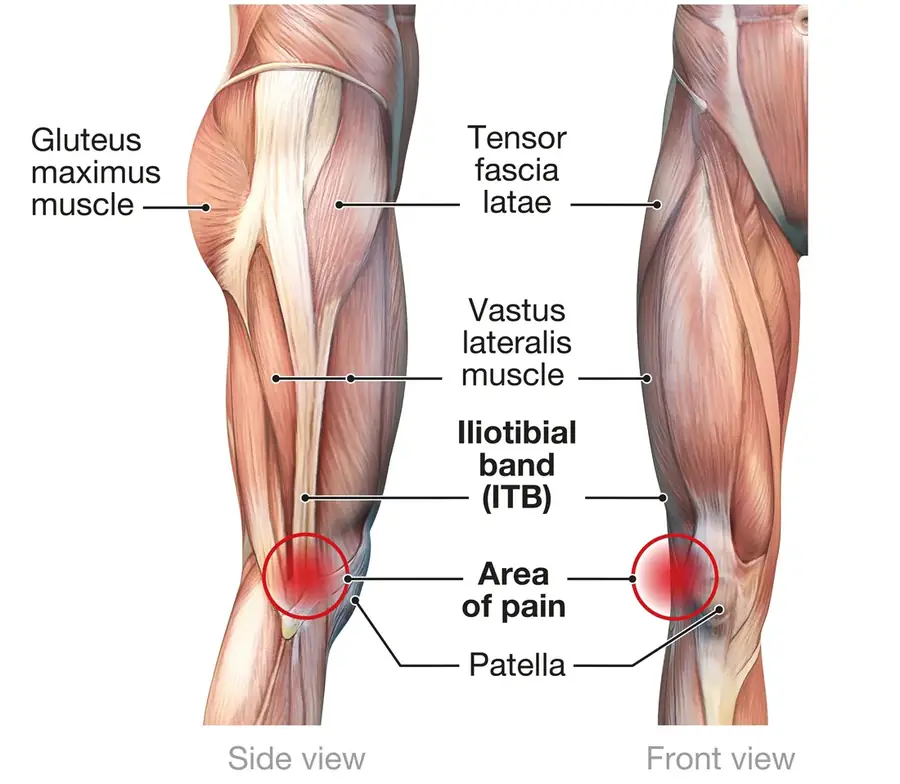
The ITB is a thick, strong band of connective tissue on the outside of the thigh. It runs from the top of the pelvis to just below the knee, on the shin bone (tibia).
Two muscles pull on it from above:
- Tensor fasciae latae (TFL) at the front of the hip
- Gluteus maximus, the large buttock muscle at the back
Together they keep the hip and knee steady each time you stand on one leg, walk, run or climb stairs.
How IT band syndrome causes outer knee and hip pain
Pain comes from the places where the band presses on bone, and from the overworked muscles above it:
- Outer knee. The band crosses a bony bump on the thigh bone (the lateral femoral epicondyle). Repeated bending, as in running and cycling, irritates the tissue underneath. This is the classic ITB syndrome.
- Outer hip. The band runs over the greater trochanter, the bony point you can feel on the side of your hip. Pain here often overlaps with gluteal tendon problems and bursitis, together called greater trochanteric pain syndrome.
- Buttock and side of the thigh. Tight, tender spots in the TFL and gluteal muscles can send pain down the side of the thigh. This is easily mistaken for back pain or sciatica.
Is it the ITB, sciatica or the joint?
Where the pain sits gives the first clue. The map below compares ITB pain with the three conditions it is most often mistaken for.
- ITB and outer hipSide of the hip, thigh and knee. Worse lying on that side, on stairs and running downhill.
- Gluteal musclesButtock ache that can spread down the side of the thigh. No numbness.
- Sciatica (from the spine)Back of the buttock and thigh, often below the knee to the foot. Numbness, tingling or weakness.
- Hip jointGroin pain, stiffness, pain putting on socks.
- Knee jointFront or inside of the knee, swelling, locking or giving way.
Simplified map for orientation only. Pain patterns overlap, and some people have more than one problem.
| ITB / outer hip | Sciatica (spine) | Hip or knee joint | |
|---|---|---|---|
| Where | Outside of hip, thigh or knee | Back of leg, often below the knee | Groin (hip); front or inside (knee) |
| Numbness or tingling | No | Common | No |
| Pressing on the spot | Tender over the band or bony point | Usually not tender in the leg | Joint line may be tender |
| Worse with | Lying on that side, stairs, running downhill, cycling | Sitting, bending, coughing | Walking, rotating the hip, squatting, kneeling |
| Scans | Often normal | MRI may show a nerve being pressed | X-ray may show joint wear |
Why it is easily mistaken for back, hip or knee disease
- A nerve from the lower back (L5) supplies the side of the thigh and leg, so back problems and ITB problems can both be felt there.
- Wear on scans is common after middle age, even in people without pain. Finding it does not prove it is the cause.
- Back pain and hip pain change the way you walk, which can overload the ITB. The reverse also happens. Read more in hip-spine syndrome.
Who gets ITB syndrome?
- Runners, cyclists and hikers
- A sudden increase in distance, hills or speed
- Weak hip muscles on the side (gluteus medius)
- Long hours sitting, which tightens the front of the hip
- A change in walking after a back, hip or knee problem
- Leg length difference or a poorly fitted bicycle
How it is diagnosed
- History and examination are usually enough: where it hurts, what makes it worse, tenderness over the band, hip strength and simple stretch tests of the band (such as the Ober test).
- Nerve examination of the leg, to check the back is not the source.
- Scans only when needed. Ultrasound or MRI if the diagnosis is unclear or pain does not settle. X-rays of the spine, hip or knee if another cause is suspected.
Treatment
- Change the load, not stop moving. Cut back distance, avoid downhill running for a while, and check bicycle seat height.
- Strengthen the side hip muscles and core. This is the most useful long-term treatment.
- Stretch the muscles that pull on the band (TFL and gluteals). Foam rolling may ease symptoms, but it does not lengthen the band itself.
- Ice and simple pain relief in the early phase.
- Physiotherapy to guide exercises and running form.
- Injection in selected cases when pain persists despite exercise.
- Surgery is rarely needed and is reserved for a small number of stubborn cases.
When to see a doctor
See a doctor if pain does not improve after about six weeks of sensible changes, or sooner for:
- Numbness, tingling or weakness in the leg
- Pain at night or at rest
- A swollen, locking or unstable knee
- Pain after a fall or injury
- Fever or feeling unwell
- New bladder or bowel problems
Frequently Asked Questions (FAQ)
1. Is ITB syndrome serious?
No. It is an overuse problem of the soft tissues, not damage to the bone or joint. Most people recover with the right changes, though it can take weeks to months.
2. Can the ITB cause back pain?
The ITB itself causes pain on the outside of the hip, thigh and knee. Tight gluteal muscles that pull on it can ache in the buttock and be mistaken for back pain. Examination helps tell them apart.
3. Does foam rolling stretch the ITB?
Not really. The band is too strong to lengthen this way. Rolling may relax the muscles around it and ease pain for a while. Strengthening the hip works better in the long run.
4. Can I keep running?
Usually yes, at a lower load. Shorter, flatter runs that stay pain-free are better than stopping completely. Build up gradually once the pain settles.
5. How long does recovery take?
Many people improve within six to eight weeks of a structured programme. Longer-standing cases can take a few months.
6. Do I need an MRI?
Most people do not. A scan is useful when the diagnosis is unclear, there are nerve symptoms, or pain does not settle with treatment.
7. What does ITB pain feel like?
A sharp or burning pain on the outside of the knee or hip, often starting at the same point in every run or ride. It is tender to press and eases with rest.
8. Can ITB syndrome cause hip pain?
Yes. Where the band crosses the bony point on the side of the hip, it can cause outer hip pain, often together with irritated gluteal tendons. Lying on that side usually hurts.
Related reading
References
- Fairclough J, Hayashi K, Toumi H, et al. The functional anatomy of the iliotibial band during flexion and extension of the knee: implications for understanding iliotibial band syndrome. J Anat. 2006;208(3):309–316.
- Strauss EJ, Kim S, Calcei JG, Park D. Iliotibial band syndrome: evaluation and management. J Am Acad Orthop Surg. 2011;19(12):728–736.
- Baker RL, Fredericson M. Iliotibial band syndrome in runners: biomechanical implications and exercise interventions. Phys Med Rehabil Clin N Am. 2016;27(1):53–77.
Pain on the outside of your hip or knee?
If it has not settled after a few weeks, an assessment can tell whether it comes from the ITB, the spine or the joint, and what will help.
Disclaimer: This article provides general medical information and is not a substitute for personalised assessment. Individual conditions vary. Please seek professional medical advice for diagnosis and treatment.