What is spondylolisthesis?
The spine is a stack of bones (vertebrae) separated by discs. Small joints at the back (facet joints) and strong ligaments hold each level in line.
In spondylolisthesis, one vertebra moves forward on the one below. The word comes from Greek: spondylos (vertebra) and olisthesis (slipping).
When the bone slips, two things can happen:
- The level becomes less stable, which can cause back pain.
- The space for the nerves narrows, which can cause leg pain, numbness or heaviness.
Grades of slip
Doctors grade the slip by how far the vertebra has moved forward across the bone below, measured in quarters. This is called the Meyerding grade.
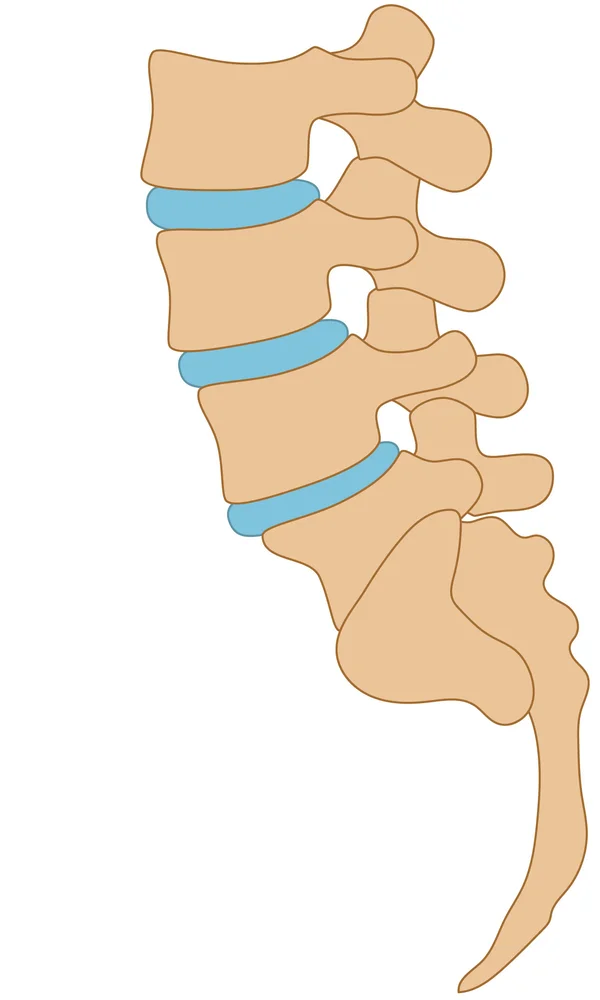 Healthy spine
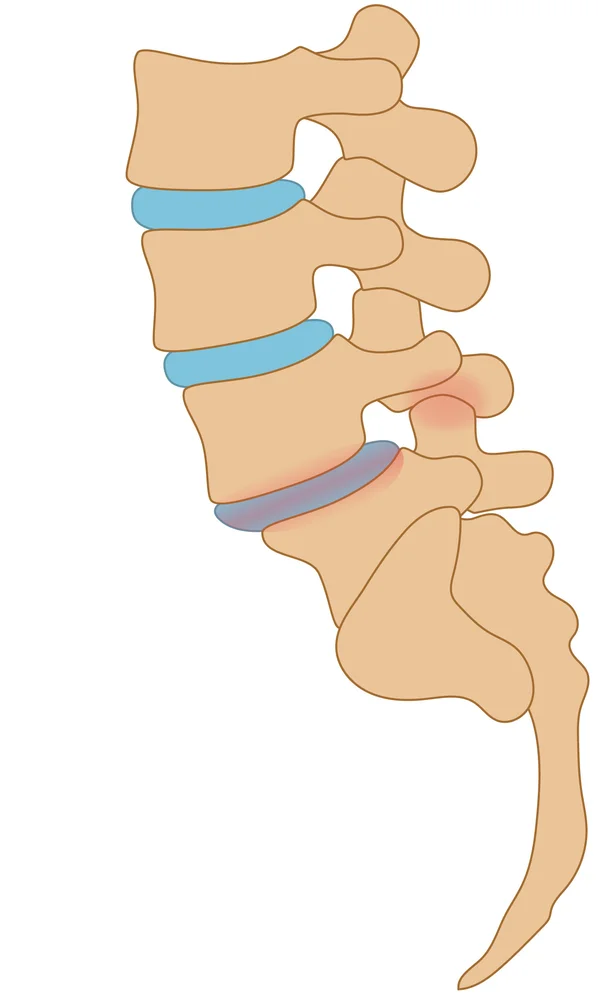 Grade 1
Low grade. Usually seen in older adults (degenerative type). Treatment depends on symptoms: many settle without surgery, but surgery may be needed if symptoms persist.
| Grade | Slip | What it usually means |
|---|---|---|
| I | Up to 25% | Low grade. Usually seen in older adults. Treatment depends on symptoms; surgery may be needed if symptoms persist. |
| II | 26–50% | Low grade. Usually seen in older adults. Treatment depends on symptoms; surgery may be needed if symptoms persist. |
| III | 51–75% | High grade. Seen more often in the growing spine of children and teenagers. Usually needs surgery. |
| IV | 76–100% | High grade. Seen more often in the growing spine of children and teenagers. Usually needs surgery. Cauda equina syndrome may occur. |
| V | Over 100% | The vertebra has slipped off completely (spondyloptosis). Very rare. Needs surgery. Cauda equina syndrome may occur. |
Types of spondylolisthesis
The cause of the slip matters, because it affects who gets it, where it happens and how it is treated.
Degenerative
The most common type in adults. Wear of the disc and facet joints lets the vertebra drift forward.
- Usually over 50
- More common in women
- Most often at L4–L5
- Usually low grade
Isthmic
Follows a stress fracture in a small bony bridge at the back of the vertebra (the pars). See spondylolysis (pars fracture).
- Often starts in childhood or teens
- Linked to sports with repeated back-arching
- Most often at L5–S1
Dysplastic
The bones at the base of the spine form differently from birth, allowing a slip.
- Rare
- Seen in children and teens
- More likely to become high grade
Less common causes include injury, previous spine surgery, and bone disease or tumour weakening the spine.
Symptoms
Some people have no symptoms, and the slip is found on an X-ray taken for another reason. When symptoms occur, they fall into these patterns:
| Pattern | What it feels like | Why it happens |
|---|---|---|
| Back pain | Ache across the lower back, worse standing, walking or bending back. Eases lying down. | Movement at the unstable level and wear of the facet joints |
| Sciatica | Pain, numbness or tingling down one leg, sometimes to the foot | A nerve root is pinched where it leaves the spine |
| Walking leg pain (neurogenic claudication) | Legs become heavy, painful or numb after walking a short distance. Better when sitting or bending forward, such as leaning on a shopping trolley. | The spinal canal narrows (spinal stenosis), squeezing the nerves |
| Cauda equina syndrome Emergency | Numbness around the back passage, genitals or inner thighs (saddle area), new difficulty passing urine or controlling the bladder or bowel, and weakness in both legs. Seek emergency care straight away. | A severe slip, usually grade 4 or 5, compresses the bundle of nerves at the lower end of the spinal canal (the cauda equina) |
How it is diagnosed
- History and examination, including a check of nerve function in the legs.
- Standing X-ray. The slip is often larger when standing than lying down, so a standing film is important.
- Bending X-rays (flexion and extension) show whether the level moves abnormally, which is a sign of instability.
- MRI shows the nerves, discs and how much the canal has narrowed.
- CT scan in selected cases, to look at the pars fracture or plan surgery.
Treatment without surgery
Most people with a low-grade slip improve without an operation. Treatment aims to calm the pain and strengthen the muscles that support the spine.
- Stay active, change the load. Short rests are fine, but long bed rest is not helpful. Avoid heavy lifting and repeated back-arching for a while.
- Physiotherapy. Core and hip strengthening, posture and walking tolerance. Exercises that bend forward are often more comfortable.
- Medication. Simple pain relief, anti-inflammatories, and medicine for nerve pain when needed.
- Weight management to reduce load on the lower spine.
- Spinal injections. An epidural or nerve root injection can ease sciatica and help you take part in rehabilitation.
- Bracing for a short period in selected cases, mainly young people with a recent pars fracture.
When is surgery considered?
- Leg pain or walking difficulty that persists despite about three to six months of good non-surgical care
- Weakness in the leg or foot that is getting worse
- A high-grade slip, or a slip that keeps increasing
- Loss of bladder or bowel control (an emergency)
In people with persistent symptoms, studies show that well-selected surgery can give better relief of pain and better function than continuing non-surgical care.
Surgical options
- Decompression. Removing bone and thickened ligament that press on the nerves. Alone, it may suit a stable slip in selected patients.
- Decompression and fusion. Freeing the nerves, then joining the two vertebrae with screws, rods and a spacer (cage) so the level stops moving. This is the most common operation for spondylolisthesis. It can often be done through smaller incisions (minimally invasive surgery).
- Pars repair. For a young person with a pars fracture and little or no slip, the fracture can be fixed directly, keeping the level mobile. See pars repair in a young dancer.
The right choice depends on your symptoms, the type and grade of slip, whether the level is unstable, your bone strength and your general health. These are discussed in detail before any decision.
When to see a doctor urgently
- New difficulty passing urine, or loss of bladder or bowel control
- Numbness around the back passage or genitals
- Weakness in the leg or foot that is getting worse
- Back pain with fever, weight loss or a history of cancer
- Severe back pain after a fall or injury
- Pain at night that does not ease with rest
Frequently Asked Questions (FAQ)
1. Is spondylolisthesis serious?
Usually not. Most slips are low grade and many cause few symptoms. It becomes more serious when nerves are badly squeezed, causing weakness or walking difficulty, or when the slip is high grade.
2. Will my slip get worse?
Most low-grade degenerative slips change little over the years. A slip is more likely to progress in children and teenagers during growth, and in high-grade or dysplastic slips. Regular review with X-rays is advised in these groups.
3. Can spondylolisthesis be fixed without surgery?
The bone usually stays where it is, but the symptoms often settle. Many people return to normal activities with exercise, physiotherapy and, if needed, an injection.
4. What exercises should I avoid?
While pain is active, avoid heavy lifting, repeated back-arching and high-impact sport. Walking, swimming, cycling and core exercise guided by a physiotherapist are usually well tolerated.
5. Does surgery put the bone back in place?
Sometimes partly. The main goals are to free the nerves and stop the level moving. Full correction of the slip is not always needed for a good result.
6. How long is recovery after fusion surgery?
Most people walk within a day or two and go home within a few days. Desk work is often possible after a few weeks. The bones take several months to fuse fully, so heavy activity is resumed gradually.
7. Can young people get spondylolisthesis?
Yes. In children and teenagers it usually follows a pars stress fracture (isthmic type), often in sports that involve repeated back-arching, such as gymnastics, dance and fast bowling.
8. Is spondylolisthesis the same as spinal stenosis?
No, but they often occur together. The slip can narrow the spinal canal, which is called spinal stenosis. This is what causes leg heaviness and pain on walking.
Related reading
References
- Kalichman L, Hunter DJ. Diagnosis and conservative management of degenerative lumbar spondylolisthesis. Eur Spine J. 2008;17(3):327–335.
- Matz PG, Meagher RJ, Lamer T, et al. Guideline summary review: an evidence-based clinical guideline for the diagnosis and treatment of degenerative lumbar spondylolisthesis. Spine J. 2016;16(3):439–448.
- Weinstein JN, Lurie JD, Tosteson TD, et al. Surgical versus nonsurgical treatment for lumbar degenerative spondylolisthesis. N Engl J Med. 2007;356(22):2257–2270.
- Ghogawala Z, Dziura J, Butler WE, et al. Laminectomy plus fusion versus laminectomy alone for lumbar spondylolisthesis. N Engl J Med. 2016;374(15):1424–1434.
Back pain or leg pain on walking?
If your symptoms have not settled, an assessment with standing X-rays can show whether a slip is the cause and which treatment suits you.
Disclaimer: This article provides general medical information and is not a substitute for personalised assessment. Individual conditions vary. Please seek professional medical advice for diagnosis and treatment.