
What happens to the neck in whiplash?
In a rear-end collision the seat pushes the body forwards, but the head lags behind. The neck is then whipped backwards and forwards in a fraction of a second. Step through the four stages below.
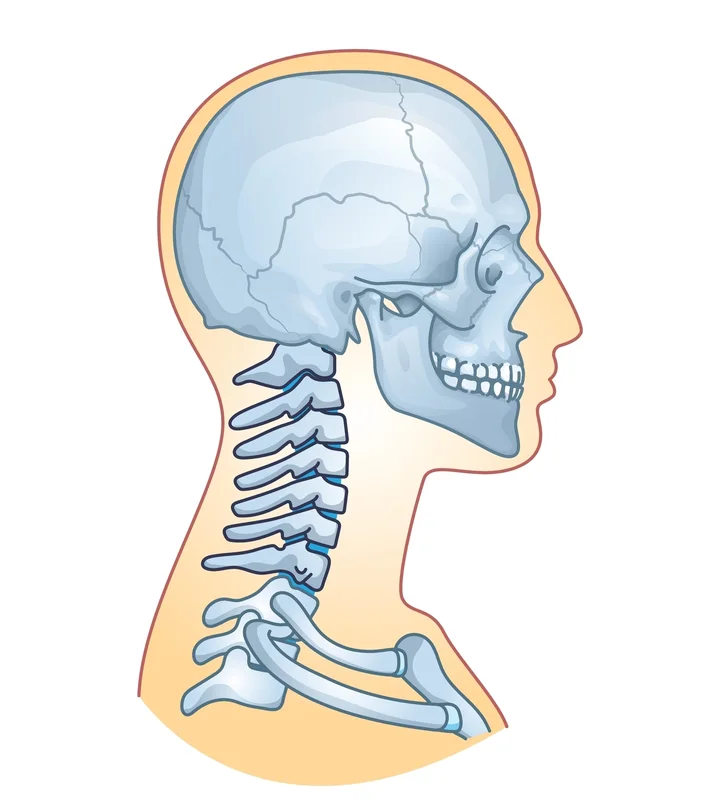
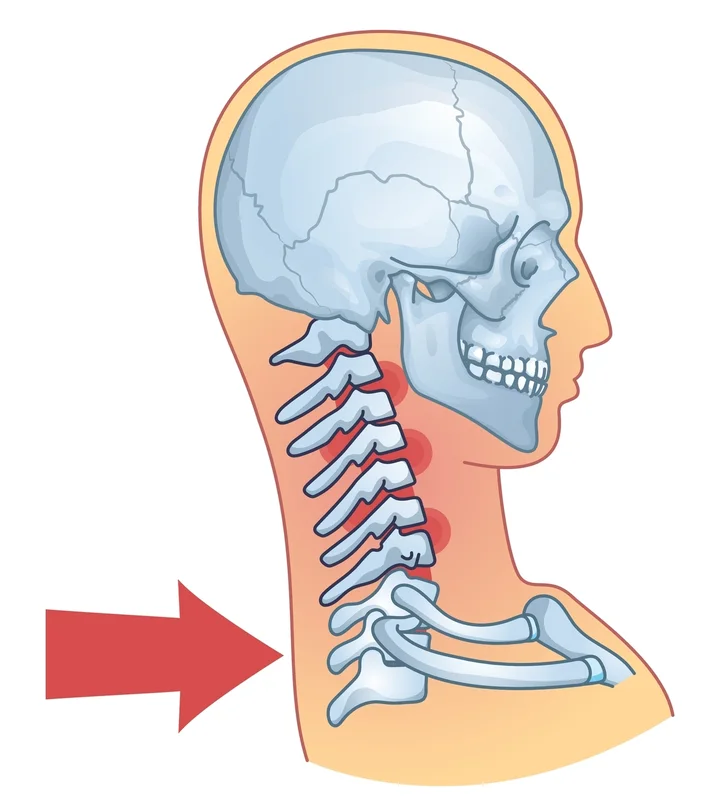
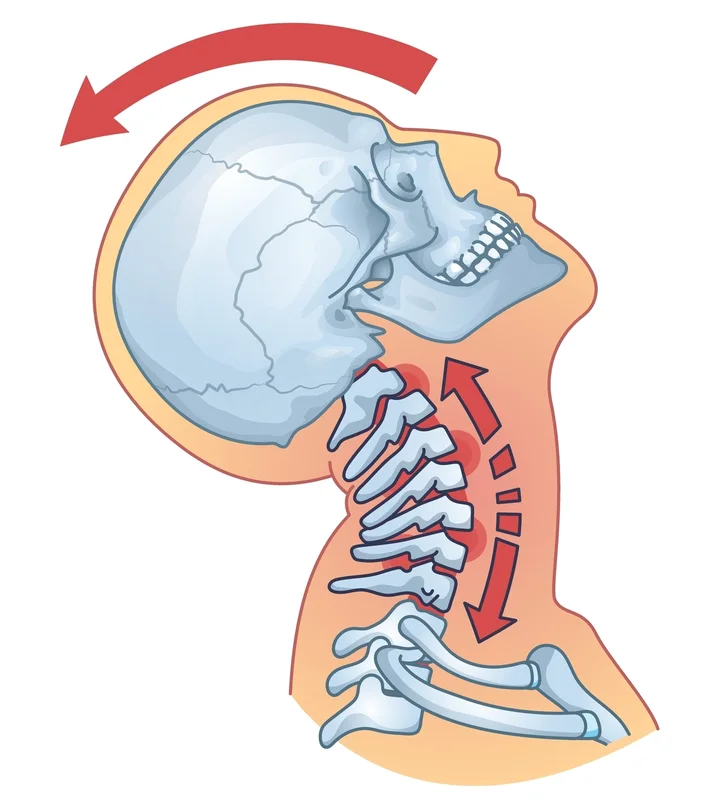
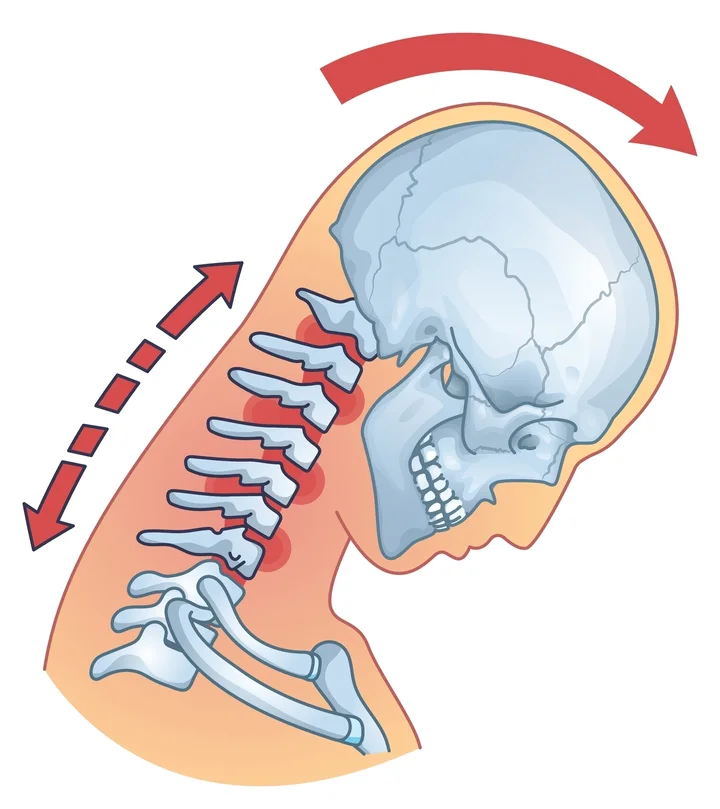
1. Resting
The neck bones sit in their normal gentle curve, supported by muscles, ligaments and small facet joints at the back.
2. Impact
The car is hit from behind. The seat pushes the body forwards while the head stays put, so the neck is suddenly strained.
3. Hyperextension (backwards)
The head is thrown backwards beyond its normal range. The front of the neck is stretched and the joints at the back are squeezed.
4. Hyperflexion (forwards)
The head then whips forwards. The muscles and ligaments at the back of the neck are overstretched. This back-and-forth motion gives whiplash its name.
Besides car accidents, similar neck sprains can follow contact sports, falls, diving, trampolining and amusement rides such as roller coasters. See roller coasters and trampolines below.
Roller coasters and trampolines
Both put sudden forces on the neck. Large studies of emergency department visits in the United States show that most of these neck injuries are sprains and strains, similar to whiplash, but serious injuries do occur.
| Roller coasters | Trampolines | |
|---|---|---|
| How the neck is injured | Rapid acceleration, braking and sharp turns jolt the head back and forth | Falls, awkward landings and landing on the head, often during flips |
| What studies found | In children, the neck was the most common site of nerve and spine injuries (44.6%), and neck muscle strain was the most common diagnosis (47.3%)6 | In children, 4.2% of trampoline injuries involved the neck; 69% of these were strains or sprains and about 1% were fractures7 |
| Rare but serious | Tears in the neck arteries (cervical artery dissection), which can lead to stroke8 | Neck fractures, and a twisted, partly dislocated top neck joint in children (atlantoaxial rotary subluxation)9 |
Staying safe
- On rides, sit upright with your head back against the headrest, and follow the height, age and health limits. Avoid rides if you have a recent neck injury or neck surgery.
- On trampolines, allow one jumper at a time, use safety nets and padding, and avoid flips and somersaults unless supervised and trained.
Symptoms of whiplash
Symptoms often build up over the first 24 hours. Common ones include:
- Neck pain and stiffness
- Headache, often starting at the base of the skull
- Pain across the shoulders and upper back
- Reduced neck movement, especially turning
- Dizziness or feeling off balance
- Tingling, numbness or weakness in the arm
- Tiredness, poor sleep and poor concentration
- Jaw pain or ringing in the ears
Whiplash grades: the WAD classification
Doctors grade whiplash-associated disorders (WAD) using the Quebec Task Force classification, from grade 0 to IV. The grade is based on your symptoms and what the doctor finds on examination. Choose a grade to see what it means.
WAD 0
- You notice
- No neck pain or stiffness.
- Doctor finds
- No physical signs.
- Usual approach
- Reassurance. No treatment needed.
WAD I
- You notice
- Neck pain, stiffness or tenderness only.
- Doctor finds
- No physical signs. Neck movement is normal.
- Usual approach
- Stay active, simple pain relief and gentle neck movement. Usually settles within weeks.
WAD II
- You notice
- Neck pain and stiffness.
- Doctor finds
- Reduced neck movement and tender spots in the muscles, but normal nerve function.
- Usual approach
- Stay active, pain relief and a guided exercise programme with a physiotherapist.
WAD III
- You notice
- Neck pain plus arm symptoms such as numbness, tingling or weakness.
- Doctor finds
- Nerve signs: reduced reflexes, weakness or loss of feeling in the arm.
- Usual approach
- Careful nerve examination, often an MRI scan, and review by a spine specialist. Most improve without surgery.
WAD IV Emergency
- You notice
- Severe neck pain after the injury, sometimes with weakness or numbness.
- Doctor finds
- A fracture (broken bone) or dislocation of the neck on X-ray or CT scan.
- Usual approach
- Emergency care. The neck is kept still and a spine surgeon decides on bracing or surgery.
Do I need an X-ray or scan?
Most people with whiplash do not need a scan. Doctors use checklists such as the Canadian C-Spine Rule to decide who needs imaging. An X-ray or CT scan is usually needed if:
- You are 65 or older
- The accident was high-impact, such as a high-speed crash, a rollover or being thrown from a vehicle, or a fall from height
- You have numbness or tingling in the arms or legs
- You cannot turn your head 45 degrees to the left and right
- There is pain or tenderness directly over the bones at the back of the neck
An MRI is used when there are nerve symptoms (WAD III), or when pain does not settle after several weeks.
Treatment
Most whiplash injuries heal with simple measures. The aim is to calm the pain and keep the neck moving.
- Keep moving. Gentle neck movement and normal daily activities, within comfort, help recovery more than rest.
- Pain relief. Paracetamol or anti-inflammatories for a short period, and heat or ice for comfort.
- Physiotherapy. A guided programme of neck and shoulder exercises, especially if pain persists beyond a few weeks.
- Injections. If pain persists for months and comes from the small facet joints, a targeted injection or nerve treatment may help in selected cases.
- Surgery is rarely needed. It is reserved for fractures, dislocations, an unstable neck, or nerve or spinal cord compression (for example from a disc injury).
How long does whiplash take to heal?
Many people feel much better within a few weeks, and most recover within three months. A smaller group has neck pain that lasts longer. This is more likely with severe pain at the start, arm symptoms, or high stress after the accident. Early, active treatment helps reduce this risk.
When to see a doctor urgently
- Severe neck pain right after the accident
- Numbness, tingling or weakness in the arms or legs
- Clumsy hands or difficulty walking
- Loss of bladder or bowel control
- Severe headache, drowsiness, confusion or vomiting
- Trouble swallowing, speaking or seeing
Frequently Asked Questions (FAQ)
1. How long does whiplash last?
Most people improve within a few weeks and recover within three months. Some have symptoms for longer, which is why early, active treatment matters.
2. Can whiplash symptoms start days later?
Yes. Pain and stiffness often appear hours to a day after the accident and may peak over the next day or two.
3. Will I need a neck collar?
Your doctor may prescribe a soft collar for a short period to rest the injured ligaments and joint capsule while they heal. Neck flexibility is then retrained with exercises. A rigid collar is used for suspected fractures.
4. Do I need an X-ray or MRI for whiplash?
Most people do not. Imaging is needed after a high-impact accident, for people aged 65 or over, with nerve symptoms, or when the neck cannot be turned. MRI is used for nerve symptoms or pain that does not settle.
5. Can whiplash cause headaches and dizziness?
Yes. Headaches from the base of the skull and mild dizziness are common after whiplash and usually settle as the neck recovers. A severe headache, drowsiness or vomiting needs urgent assessment.
6. Can whiplash cause arm pain or a slipped disc?
It can. Arm pain, numbness or weakness suggests a nerve is affected (WAD III), sometimes from a disc injury. This needs a nerve examination and often an MRI.
7. Can I exercise or drive after whiplash?
Gentle activity is encouraged. Drive only when you can turn your head fully to check blind spots without pain, and you are not taking medicine that makes you drowsy.
8. When should I see a spine specialist?
See a specialist if you have arm symptoms or weakness, if pain is severe, or if your neck has not improved after about six weeks of treatment.
Related reading
References
- Spitzer WO, Skovron ML, Salmi LR, et al. Scientific monograph of the Quebec Task Force on Whiplash-Associated Disorders: redefining “whiplash” and its management. Spine. 1995;20(8 Suppl):1S–73S.
- Stiell IG, Wells GA, Vandemheen KL, et al. The Canadian C-spine rule for radiography in alert and stable trauma patients. JAMA. 2001;286(15):1841–1848.
- Rosenfeld M, Seferiadis A, Carlsson J, Gunnarsson R. Active intervention in patients with whiplash-associated disorders improves long-term prognosis: a randomized controlled clinical trial. Spine. 2003;28(22):2491–2498.
- Carroll LJ, Holm LW, Hogg-Johnson S, et al. Course and prognostic factors for neck pain in whiplash-associated disorders (WAD): results of the Bone and Joint Decade 2000–2010 Task Force on Neck Pain and Its Associated Disorders. Spine. 2008;33(4 Suppl):S83–S92.
- Lamb SE, Gates S, Williams MA, et al. Emergency department treatments and physiotherapy for acute whiplash: a pragmatic, two-step, randomised controlled trial. Lancet. 2013;381(9866):546–556.
- Patel J, Carnovale B, Rabon W, et al. Characterization of neurological injuries from roller coaster rides among minors. Am J Emerg Med. 2025;98:309–314.
- Akella DS, Walsh J, Raghavan M, et al. Pediatric neck injuries associated with trampoline use. Am J Otolaryngol. 2025;46(1):104564.
- Nouh A, Vela-Duarte D, Grobelny T, et al. Internal carotid artery dissection after a roller coaster ride in a 4-year-old: case report and review of the literature. Pediatr Neurol. 2015;52(3):349–351.
- Kanagaraju V, Srinivasan SDK, Elsayed S, Ponnappan RK. Atlantoaxial rotary subluxation in children after trampoline injury: a critical but overlooked diagnosis. J Craniovertebr Junction Spine. 2024;15(4):515–518.
Neck pain after an accident?
If your pain is not settling, or you have arm symptoms, an assessment can check the nerves, decide whether you need a scan and plan your recovery.
Disclaimer: This article provides general medical information and is not a substitute for personalised assessment. Individual conditions vary. Please seek professional medical advice for diagnosis and treatment.